


Geogrid-reinforced steep slope along the motorway
Project information
Construction project
Expansion of the A40 motorway from the Duisburg-Homberg interchange to the Duisburg-Häfen interchangeCustomer
DEGES German Unity Highway Planning and Construction GmbHConstruction
Heitkamp Brückenbau GmbHLocation
Duisburg, Germany , DEPlaning
Engineering office for civil engineering, SalzburgConstruction time
May 2025 - September 2025Products used
Project details

Situation
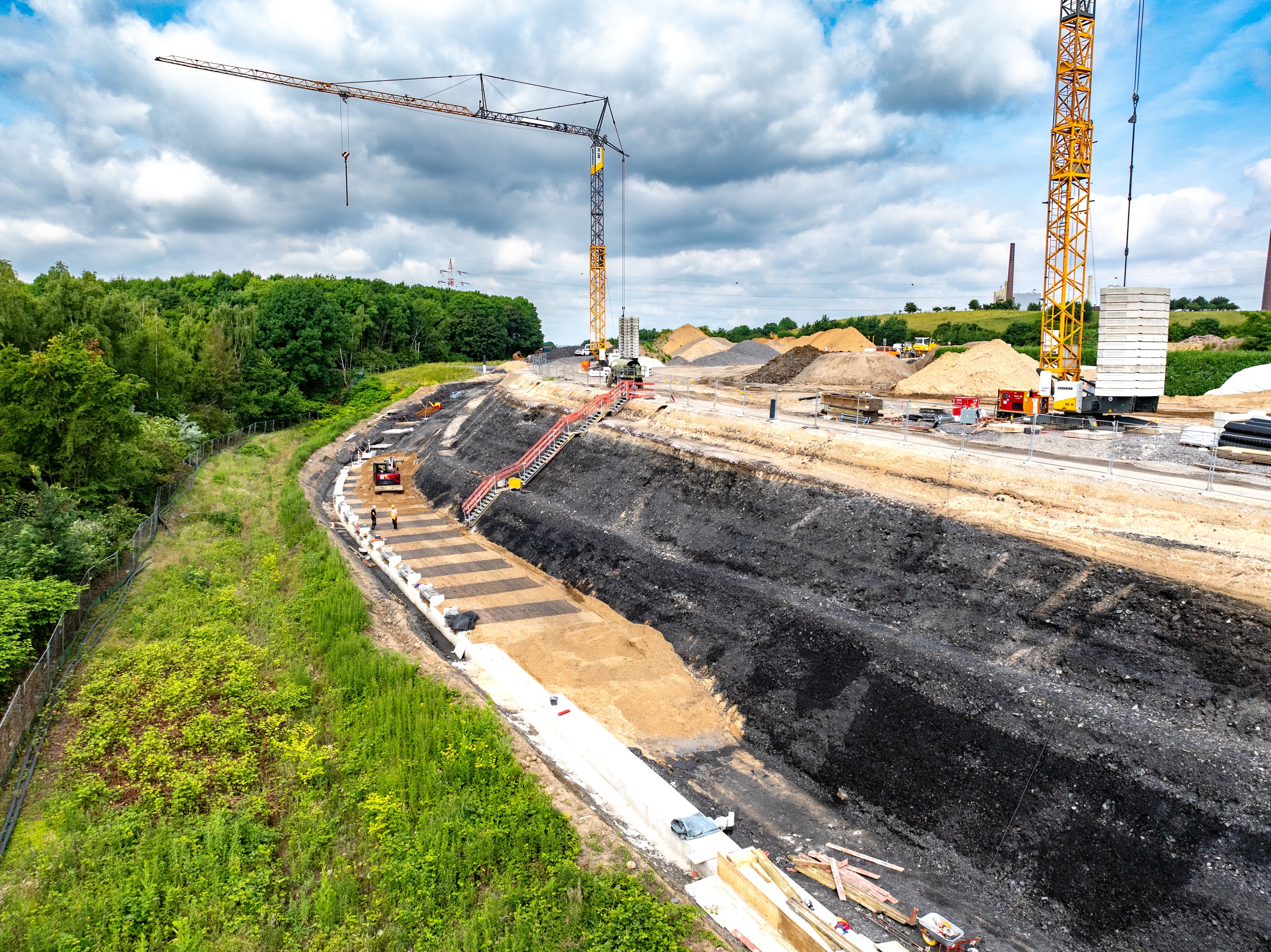
On behalf of DEGES Deutsche Einheit Fernstraßenplanungs- und -bau GmbH, work is currently underway to widen the A40 motorway to eight lanes between the Duisburg-Homberg and Duisburg-Häfen junctions. In addition to widening the main carriageway, the project also involves adapting the adjacent traffic areas and constructing a new replacement for the Duisburg Neuenkamp bridge over the Rhine. Particular conditions had to be taken into account, especially during the redesign of the Homberg junction and the necessary construction of the new Venlo – Duisburger Straße exit ramp there: to keep land use in the adjacent nature reserve to a minimum, the construction of a steep embankment was required. As an alternative to the space truss wall envisaged in the planning approval, the client opted for the construction of the slope stabilisation in the form of a geogrid-reinforced steep embankment with a front face formed from precast concrete elements.
Solution
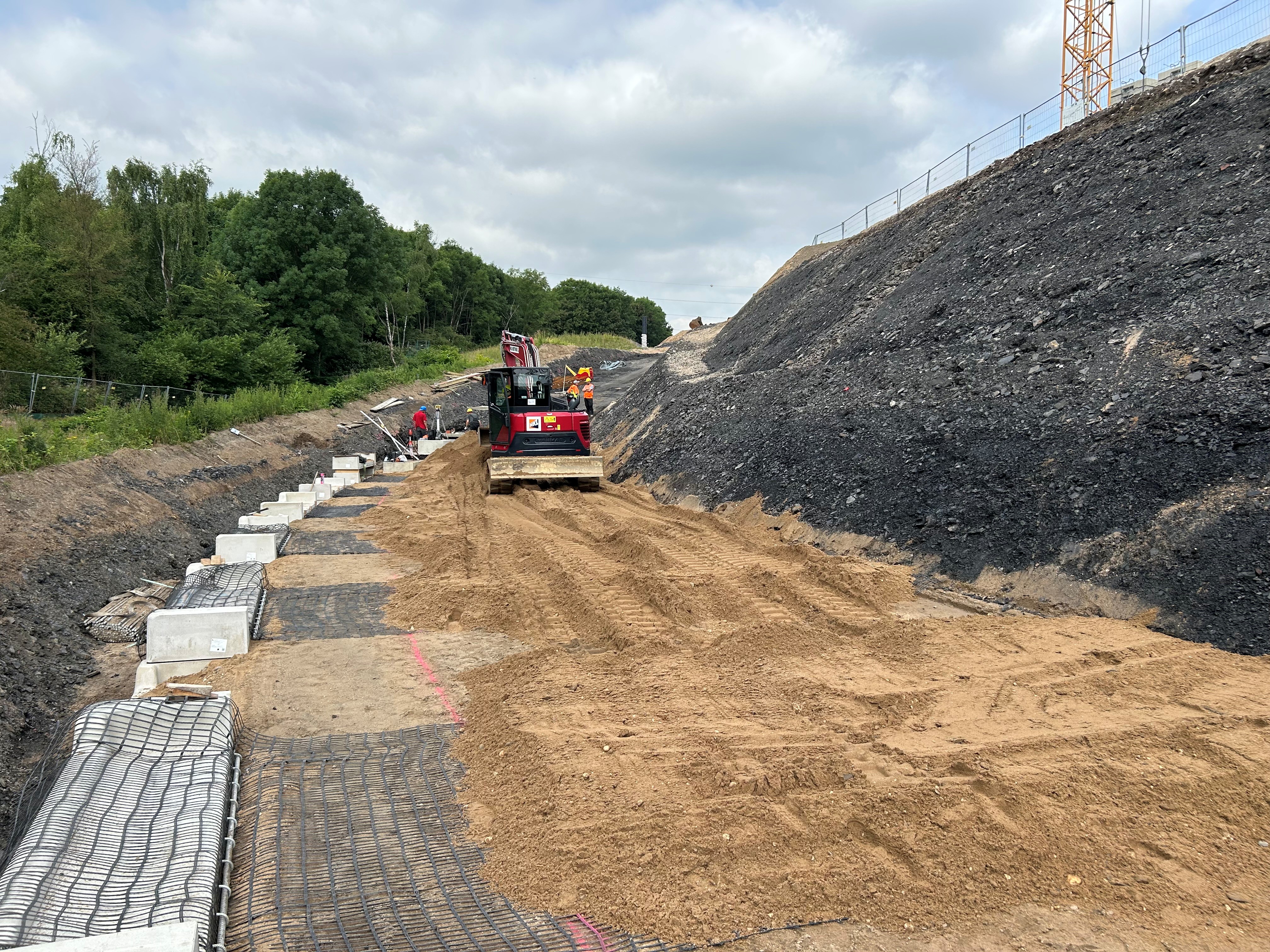
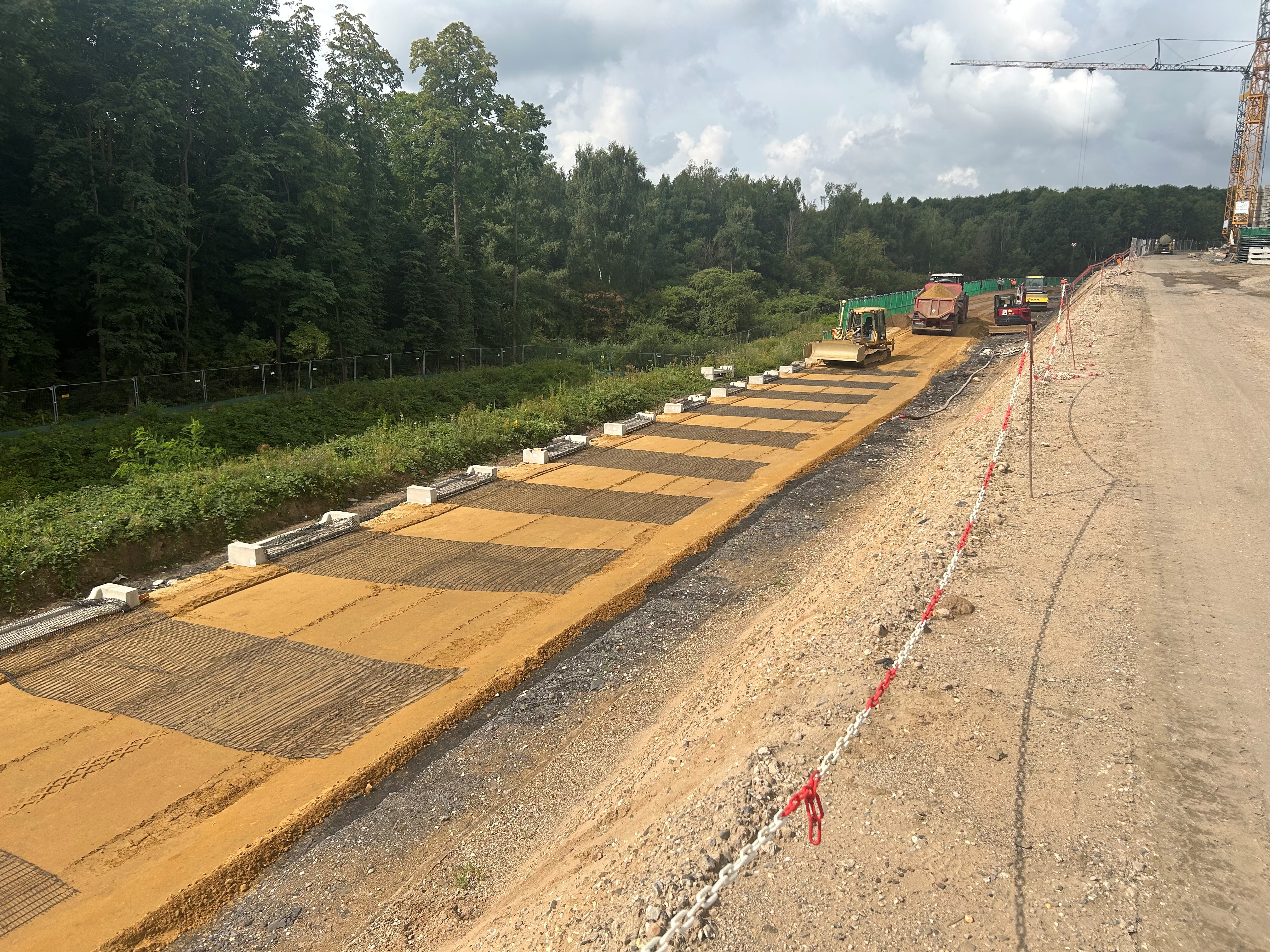
The Fortrac® NEWmidi system was used to construct the steep embankment. In this system, high-quality precast concrete elements are arranged in a chequerboard pattern and anchored to the ground using high-strength geogrids. In Duisburg, the structure reaches a total height of up to 9.5 m. The length of the structure is approximately 350 m. Unlike with a space truss wall, this construction method requires only solid in-situ concrete foundations to serve as mounting bases for the precast elements. The foundations for the space truss wall alone would have required around 3,300 m³ of concrete, corresponding to a material weight of over 8,000 tonnes. The design of the steep embankment using Fortrac NEWmidi was carried out in close consultation with HUESKER Synthetic GmbH.
Advantages
In contrast to the conventional grid-reinforced retaining wall originally planned, the implementation of the alternative proposal involving a geogrid-reinforced steep slope has yielded significant technical, economic and environmental benefits. Whilst with space truss walls, the compaction of the fill material within the truss cells is very limited due to the confined space and is predominantly only possible using small equipment – particularly in gusset areas and immediately above the load-bearing elements – the geogrid-reinforced retaining structure allows for the creation of a homogeneous, high-quality and mechanically compacted earth structure. This significantly reduces the risk of increased self-deformation of the retaining structure and the potential for differential settlement between the existing structure and the new construction, as would have been expected with the official proposal.
Furthermore, the slim, flexible construction method led to a shorter construction period and opened up considerable potential for savings in the foundation works, as the chosen design did not require a concrete foundation extending across the entire footprint of the slope stabilisation. Overall, the alternative construction method thus proves to be significantly more resource-efficient and sustainable than a space truss wall.
At the same time, however, the external appearance remains very similar to the originally planned design, which allows for greening, and blends harmoniously into the lush surroundings. The Fortrac NEWmidi system thus represents a high-performance, cost-effective and sustainable solution for the expansion of the A40 motorway in the vicinity of the Duisburg-Homberg and Duisburg-Häfen junctions.
Further information